


Avignon Festival: Silence, the Masterpiece Making a Big Noise, by Mathilde Monnier and Lucie Antunes
par Amélie Blaustein08.07.2026

In the Carrière Boulbon of Avignon, configured in a tri-frontal setup like never seen before, the choreographer Mathilde Monnier and the musician Lucie Antunes deliver the first absolute masterpiece of this 80th edition, in a piece that questions the relationship between music and dance — and gives an answer: fusion.
“Silence, Silence, Silence”
The Carrière Boulbon is a legendary site of the Avignon Festival, discovered by Peter Brook in 1985. It remained closed throughout Olivier Py’s tenure. Tiago Rodrigues’ very first act, three years ago, was to reopen it with the help of sustained sponsorship. But here, the staging offers us a completely unprecedented view of the stone. We now find ourselves surrounding the stage, our backs to the wall we’ve so often seen from the side. The stage, moreover, is doubled: a white circle at the center of an almost-square black space. And at the center of that circle sit musical instruments, many of them. Some we can name — a piano, a drum kit — and others we can’t, like this control-tower-like structure full of cables which, as we’ll see, is used to twist the sound in fascinating ways.
“Time Has Gone Mad”
Twisting sound and twisting bodies, or at least breaking them a little, a little a lot, in order to unfold them properly, is the guiding principle of this Silence, which is anything but calm. It all begins with a chorus, a true chorus uniting the dancers and musicians: Lucie Antunes, Canblaster, Hans Peter Diop, Lucía García Pullés, Martín Gil, Thiago Granato, Vega Voga, Carolina Passos Sousa, Sophia Seiss, and Judit Waeterschoot. All guided by Lucie, they proclaim: “Silence.” A sonic silence, then. The multi-instrumentalist’s sound is instantly recognizable through its electronically organic layers.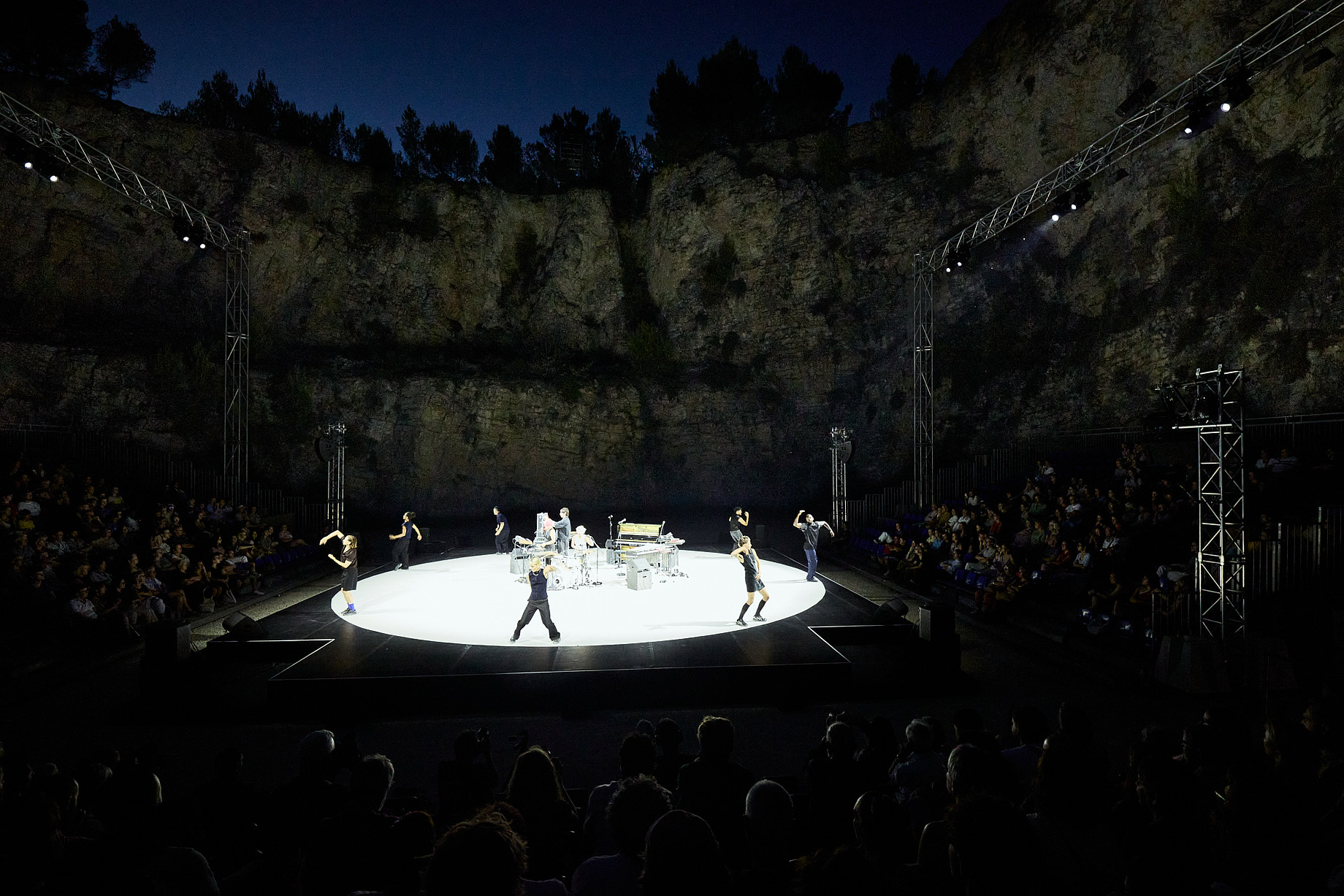
“I Am Mad”
Since Balanchine at least, dance has been asking itself whether it should stay in rhythm, follow the tempo, illustrate the notes. What if the question were posed differently: can one be both the music and the movement in total equality? Yes, says Mathilde Monnier, casting her marvelous dancers in a circle and — exhausting to watch! — having them continuously circle it while extending arms or bending their torsos, each one differently. Then, no pun intended, it becomes a visual and sonic feast. The pieces shift from techno to something almost rock, and the voices bring in poetry, notably that of Laura Vazquez, which, at last, lets love resonate in this edition’s otherwise harsh themes so far.
“I Am Inside the Night”
Technically, the choreography is monumental in its precision and composition. Certain gestures are bound to mark the history of dance, we already know it — hands trembling so fast they seem to run down into the legs, or a loving pas de deux seeking to intertwine without ever being literal. Arms hanging behind backs like vines in the wind. Or controlled stiffness in elbows and knees that halts movement only to launch another.
“I Love You”
Silence is a splendor in both substance and form. It is a true concert, a spectacle, and a choreography all at once. Silence has, for the past few days, also been an album. The piece dissolves the boundaries between dance and music. There is trance in it, a way of entering the body that follows the very structure of notes. It is a genuine enveloping, on every level, between the piece and the audience. It is an utterly new gesture, worthy of the Avignon Festival’s reputation for avant-garde ambition and rigor.
Silence, de Lucie Antunes et Mathilde Monnier, sera présenté les 3 et 4 novembre à La Comédie de Valence.
Visuel : ©Christophe Raynaud de Lage


