


Cannes, jour 4 : James Gray en mode mafia, Sorogoyen puissant et le rdv raté avec l’horreur coréenne
par La redaction17.05.2026

The competition is in full swing this Saturday, May 16th, on the Croisette, which is packed with people. There’s no room to move, and there’s everything to see, as Scarlett Johansson ascends the famous steps of the Palais des Festivals. But our favorite film in the competition is Rodrigo Sorogoyen’s El ser Querido, in which Javier Bardem shines.
By Paul Fourier, Amber Kinui, Rachel Rudloff and David Hanau.
Yeon Sang-ho’s Colony in a special screening
You have to start a day in Cannes with a film, even if it’s… bad. Colony , by Korean director Yeon Sang-ho, presents itself as Die Hard in the land of zombies, with a dash of Alien . But in reality, it’s almost difficult to classify it as horror, given how much it reuses of well-worn tropes. It features a biotechnology professor who witnesses, at a conference, a virus contaminating an entire building in the heart of Seoul before the infected begins to crawl… You barely jump out of your skin twice in front of the big screen and leave feeling rather disappointed.
Sorogoyen, or the difficult reconstruction of a father-daughter relationship
A famous director offers a dream role to his daughter, whom he abandoned thirteen years earlier. She seizes the opportunity, fully aware that this role will reopen old wounds and unspoken secrets… With El ser Querido , Rodrigo Sorogoyen delivers a stark and even violent film. Javier Bardem is superbly unsettling.
Our review is coming soon.
James Gray and the return to the eighties
In 1980s Queens, two very different brothers join forces for a shady deal involving the Russian mafia—an initiative that draws them into a spiral that throws everything into question. With Paper Tiger , James Gray delivers a virtuoso mafia film. The problem is that Little Odessa was far more subtle and already deeply nostalgic, and the screenplay is reminiscent of dozens of films of the genre seen over the last forty years, including those by De Palma and Scorsese. The acting is excellent, the pacing is gripping, Scarlett Johansson and Adam Driver are convincing—but unfortunately, it doesn’t bring much new to the genre or to American cinema.
Our review is also coming soon.
Suddenly , or the possibility of a Palme d’Or
We caught up with Ryūsuke Hamaguchi’s new film, *Suddenly *, at a screening—and the least we can say is that the 3 hours and 16 minutes didn’t feel long at all. Or rather, they did: Hamaguchi deliberately embraces the stretching of time, these long, recurring discussions, these scenes that repeat themselves as if to deepen their impact, until you feel like you’re spending an entire night with the characters. A risky gamble, but it paid off. Virginie Efira is once again magnetic—all restrained passion and captivating professionalism—while Tao Okamoto offers a counterpoint of rare gentleness and humility, in a performance of such restraint that it is all the more moving. Between the two, something is forged that is as much love at first sight as it is a philosophy of care. A film in the official competition that speaks of the dignity of the elderly, of madness as resistance, and of humanity as a practice—and perhaps one of the great films of this competition.
The fourth night of the Directors’ Fortnight included two consecutive feature films starring eponymous female protagonists.
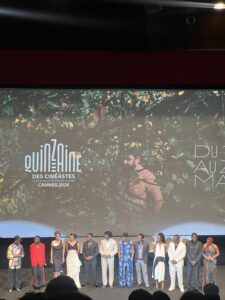
Clarissa, directed by brothers Arie and Chuko Esiri, alternates between present-day reflections on maturity and memories of her twenties, interwoven with stories of friends, family, war, and a celebration of national culture. Clarissa (Sophie Okonedo) is loved and surrounded by friends, yet characterized as a difficult person, making her a particularly fitting narrator in her own right. However, the narrative is told from multiple perspectives, primarily Clarissa’s friends, but the film’s strength lies in the poignant personal stories of Clarissa’s staff, which speak to both their dedication and the challenges of navigating their country. Set in both Lagos, Nigeria, and the summer resort town of Abraka, the film highlights the ecological diversity and experiences of Nigeria’s upper class, including how they grapple with their identity, the hardworking people who serve their country, and the precious and complex history of their nation. The full article is forthcoming.
Shana: Gracefully Feminist, Gloriously Lucid
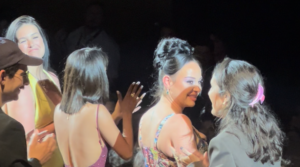
Shana, directed by Lila Pinell and starring Eva Huault, is a woman living in Paris who inherits her grandmother’s ring as protection against the evil eye. Shana unabashedly loves « bling » and wild parties, but this shouldn’t be mistaken for a lack of character. She is loyal to her family, her best friend Inés, and her ex-boyfriend Moses, who tries to teach her the ropes of his drug trafficking between his stints in prison. Shana hopes her grandmother’s ring will help her avoid trouble, and although she has her emotional outbursts, she demonstrates wisdom and a desire to improve her life by understanding the origins of her tendencies, all while remaining true to herself in the process. With a little help from her best friends and her neighbor, Shana remains gracefully feminist and a believable muse who captures the nuances of both family dynamics and the realities of the street.
In a thrilling twist, Shana is her own worst enemy, but she also displays remarkable insight, revealing a sociological understanding through humor and improvisation that only she can achieve. Pinell and Huault have an ongoing working relationship, and Shana is no exception: Huault knows how to deliver a sincere performance while entertaining her audience.

Cannes, compétition : « El ser querido », un vertige de l’amour entre père et fille
par Paul Fourier17.05.2026
→ Lire l’article

Les Caprices de l’Enfant Roi, de Michel Leclerc : vive le théâtre, vive le roi
par Amber Kinui17.05.2026
→ Lire l’article

