


The muddled debacle of Milo Rau’s “Flying Dutchman” at the Deutsche Oper Berlin
par Hannah Starman03.11.2026

On 24 October 2026, Milo Rau’s new production of The Flying Dutchman was booed: too ignorant to be convincing, too insipid to spark debate and too jumbled to provoke controversy, Milo Rau conveys a sinister message and uses the music as a soundtrack to accompany his supposedly explosive narratives, which fall flat.
The Flying Dutchman according to Milo Rau: a redemptive sacrifice to save Germany
“The Flying Dutchman is an opera about the contemporary effects of historical trauma,” states Milo Rau in the interview accompanying the programme. This observation promises a bold and original project. Numerous sociologists, anthropologists, political scientists, psychologists, legal experts and historians have examined the societal impact of collective traumas, amongst which the extermination of European Jews remains a major signifier for mass violence in the 20th century. An opera tackling this subject with intelligence, discernment and sensitivity could have offered a fresh perspective on an era that so desperately needs it.
However, Milo Rau’s treatment of The Flying Dutchman as ‘the relationship between Germany and Israel’, and his staging—which relies on assigning archetypal roles to Wagner’s characters—lead the narrative towards a resolutely perverse conclusion. The Dutchman, whom Wagner himself linked in 1851 to the myth of the Wandering Jew in A Letter to My Friends, embodies Germany in Rau’s production – a reversal of roles brilliantly explored by Elgar Hilsenrath in his scathing farce The Nazi and the Barber. Senta, the Norwegian captain’s daughter, represents here “Israel or the Jews” (the conflation is deliberate). The old portrait of the Dutchman that Senta gazes at adoringly is that of Richard Wagner, “the cultural symbol of German guilt”, and Erik is “a Palestinian who lives with Senta on the same land”.
Fair enough. But the problem with any opera is that it follows its own music and cannot easily be pressed into a narrative mould. On the other hand, attempts to do so are always revealing. Rau attributes the Wagnerian fate of the Wandering Jew to Germany. The myth emerged in the 13th century and served, right up until the 20th century, as a theological argument that God had condemned the Jewish people to exile and eternal suffering as a collective punishment for rejecting Christ, before its triumphant resurgence in Nazi anti-Semitic propaganda (Der Ewige Jude). But whilst the Wandering Jew could hope to find salvation through conversion to Christianity, Germany’s redemption, according to Milo Rau, demands that Israel and the Jewish people perform the ultimate sacrifice. Alas, the idea is neither new nor trivial.
In The Pity Of It All: A Portrait of the German Jewish Epoch 1743–1933, Amos Elon describes the history of the assimilated German Jews who contributed disproportionately to German culture and science (25 per cent of German Nobel Prizes were awarded to Jews, who accounted for 0.8 per cent of the population), before being persecuted and then exterminated by the Nazi regime. Observing that the Jews – a nation without a homeland – ‘infiltrate their host nations’, ‘threaten their racial purity’ and ‘transform their culture’, Hitler argues in Mein Kampf that only the total eradication of German Jews will save Germany. He set about this with the messianic zeal of a ‘warrior of Christendom’, as he described himself in a 1926 speech, in which he stated his intention to ‘complete the work that Christ had begun but was unable to finish’.
In biblical times, the Holocaust was a religious sacrifice in which an animal offering – the scapegoat – was entirely consumed by fire and offered to God. Today, the term primarily refers to the extermination of European Jews and other ‘undesirables’ by the Nazis. In Milo Rau’s production of The Flying Dutchman, the Dutchman (Germany) is to be delivered from original sin (the Holocaust of the Jews) through Christ-like sacrifice by Senta (the Jews or Israel). The descendants of the Jews who were sacrificed on the altar of German racial purity between 1933 and 1945 should, according to Rau’s narrative, thus willingly sacrifice themselves to deliver the German people, not only from their historical guilt towards the Jews, but also from their current guilt towards the victims of their unconditional support for the State of Israel.
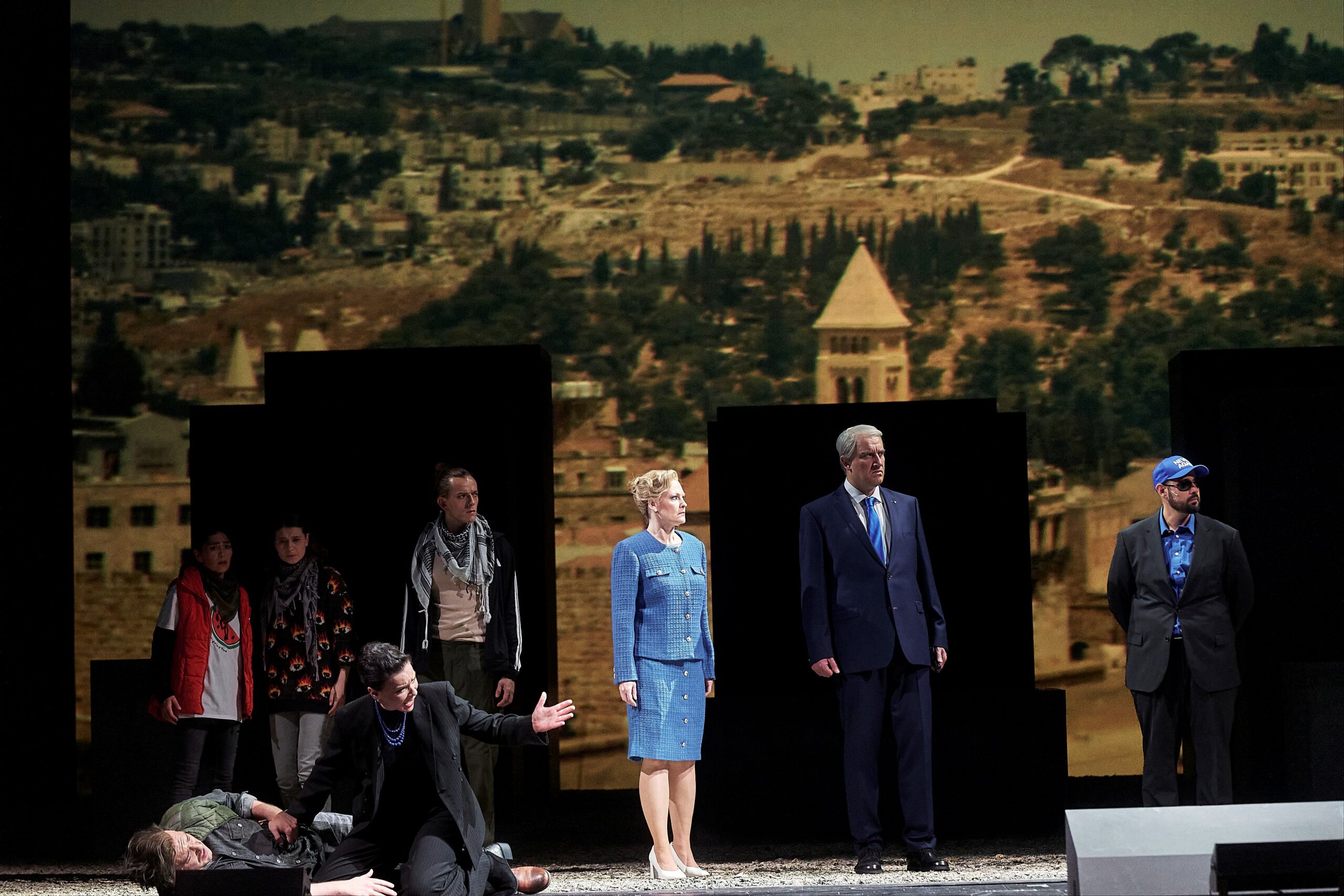
Just before shooting herself in the head at the end of The Flying Dutchman, Senta clings to her childhood friend and former fiancé, Erik (the Palestinian), who has been mortally wounded by Mary (‘the shield of Israel’) after attempting to strangle Senta. As he lies dying, he reminds his beloved of their shared past. Torn between her affection for Erik, her passion for the Dutchman and the imperative of her sacrificial mission, Senta wavers between the two men until Erik’s death. She then offers her own redemptive death to the Dutchman: “Israel or the Jews” destroys itself to preserve “Germany”. We are only a conceptual stone’s throw away from “the most diabolical crime of National Socialism”, as described by Primo Levi in The Drowned and the Saved, which consisted of forcing Jews to contribute to their own destruction in order to preserve the mental health of their tormentors.
This “sacrificial” narrative arc is steeped in a medieval mystical anti-Semitism that resurfaced in the 19th century in the form of esotericism. The racial and spiritual hierarchy developed by the founder of the Theosophical Society, Helena Blavatsky, who regarded all Semites, Arabs and Jews as ‘spiritually degenerate’, in turn inspired Nazi Ariosophy and occultism. Above all, however, it conveys the message that “Israel or the Jews”, through the very tenacity of their existence, trap Germany in a cycle of guilt from which there is no escape. Consequently, only their total disappearance will offer Germany a peaceful and fulfilling existence.
The transposition of 20th-century history onto The Flying Dutchman draws, whether consciously or subliminally, on a deeply toxic imagination and leads to a conclusion that proves one cannot touch mud without getting dirty. Does Milo Rau’s Flying Dutchman call for a new sacrifice by the Jewish people to save the German people? Does it call for the disappearance of the Palestinian people to liberate the German soul, wounded by the guilt of having supported Israel? Has Milo Rau even considered where his narrative logic would lead him? Is this an unfinished thought, or are we witnessing Hannah Arendt’s “void of thought into which evil enters?”
A truncated historical narrative and a staging that detracts from the music
To this conceptual foundation, Milo Rau adds three narrative layers: a road movie through Israel and the occupied territories, to perform Wagner’s music there; personal stories; and the history of relations between Germany and the Jews, and subsequently with Israel. Listening to the music will be constantly disrupted – in addition to the action on stage – by videos of witnesses projected onto the screen with subtitles, footage from the Wagnerian road movie, and historical explanations of varying degrees of accuracy.
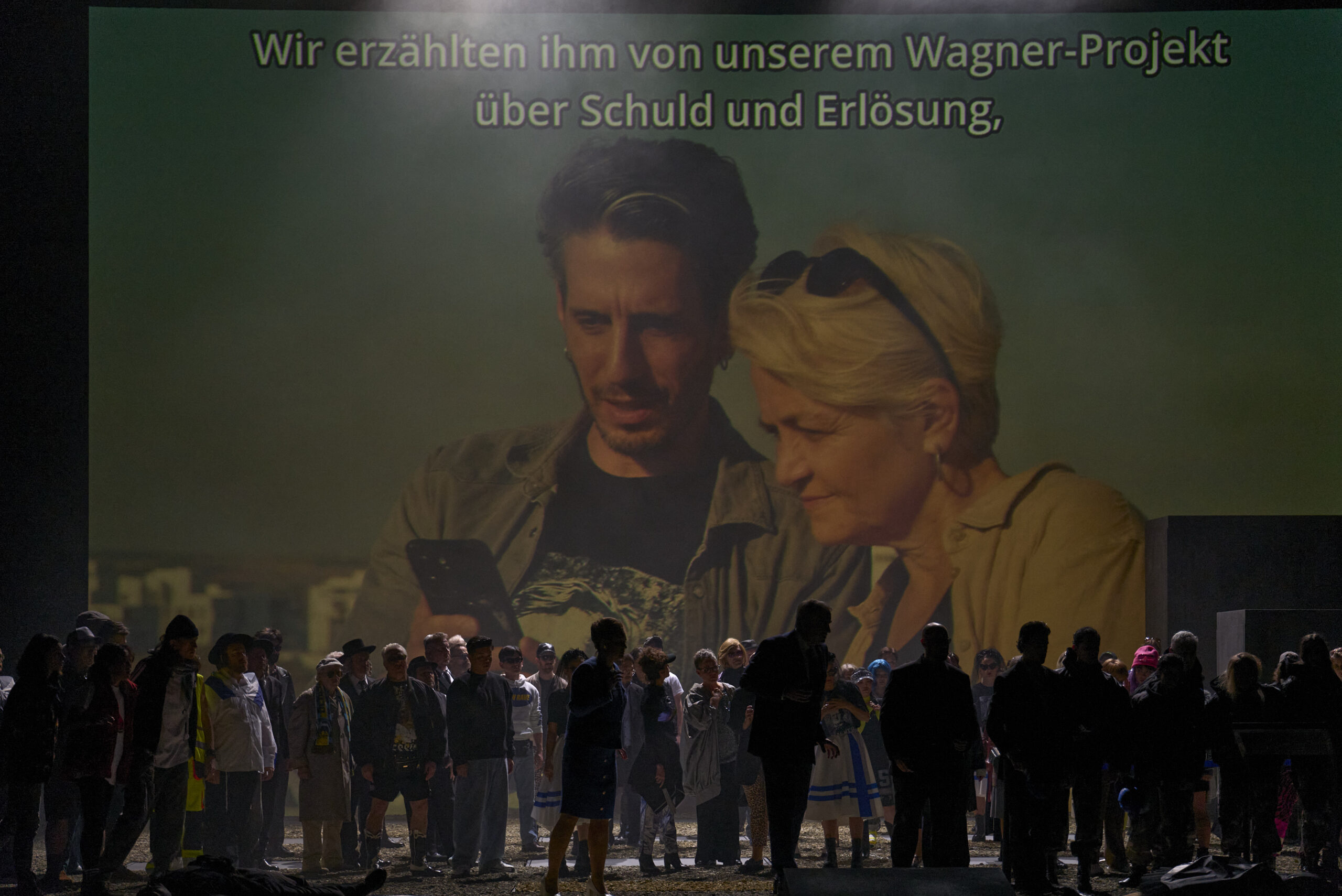
The narrative begins in front of a lowered curtain: the narrators, Sarah von Schwarze and Schlomi Wagner – one speaking in German, the other in Hebrew – share a few fragments of their lives. The Israeli actress speaks of her grandfather, who ‘was in the Wehrmacht’, her parents’ conversion to Judaism, their move to Israel and her childhood, surrounded by Holocaust survivors. She concludes with a poignant remark: “I was the one who paid the price for my parents’ guilt.” Schlomi Wagner, an Israeli performer and drag queen, shares his enthusiasm for Richard Wagner’s music and describes performing his works in Israel. Then, Von Schwarze signals to the orchestra: ‘Maestra, the music.’
During the overture, portraits and personal stories of the singers in their stage costumes are projected onto the screen at the back of the stage. We learn that several singers have links to Germany, the former USSR or the Middle East, and that Kai Rüütel-Pajula was born on 5 September, ‘the date of the hostage crisis at the Munich Olympics’. This overloaded introduction makes it clear that Milo Rau attaches very little importance to the music. Instead of appreciating these ten minutes of rare dramatic intensity, with rapid, chromatic string movements evoking the raging sea, the audience struggles to read the text, of which only snatches can be made out.
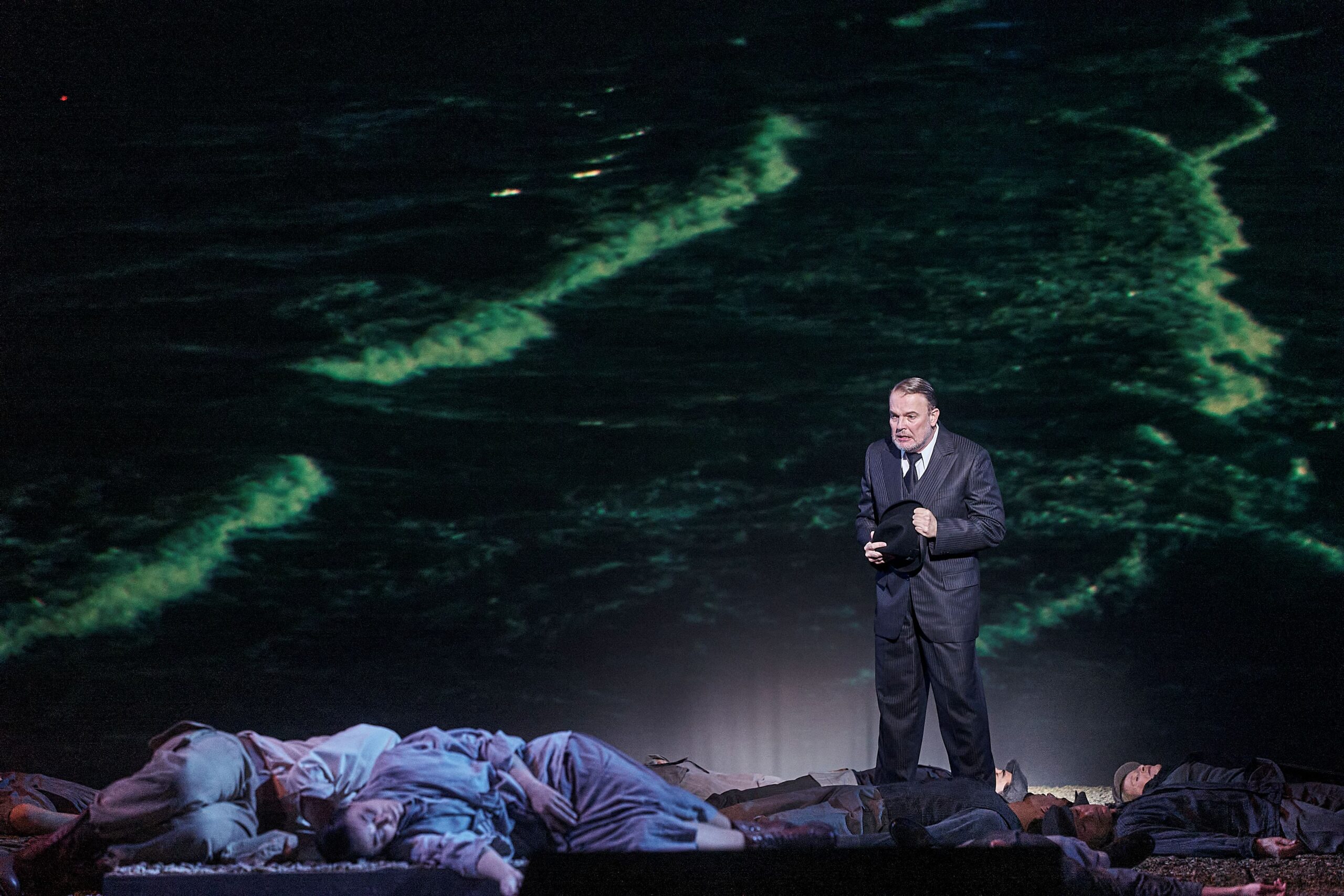
The first scene – superbly conceived and executed – plunges us into the abyss of the Holocaust. Concrete blocks evocative of the Memorial to the Murdered Jews of Europe in Berlin take shape in the darkness. In a sombre, unsettling atmosphere, the Dutchman (Tomasz Konieczny), dressed in a black SS uniform, holds a revolver and assists Sarah von Schwarze, who kills the extras one by one with a stylised, elegant gesture reminiscent of the Vulcan nerve pinch. Schlomi Wagner films the massacre live, projected onto the screen and designed by Moritz von Dungern. ‘It all begins with guilt,’ reads the text on screen. And a little later: ‘Wagner’s music was performed in Katowice, some forty kilometres from Auschwitz. As they left the opera house, the audience could see the red sky above Auschwitz, where bodies were being burned.’
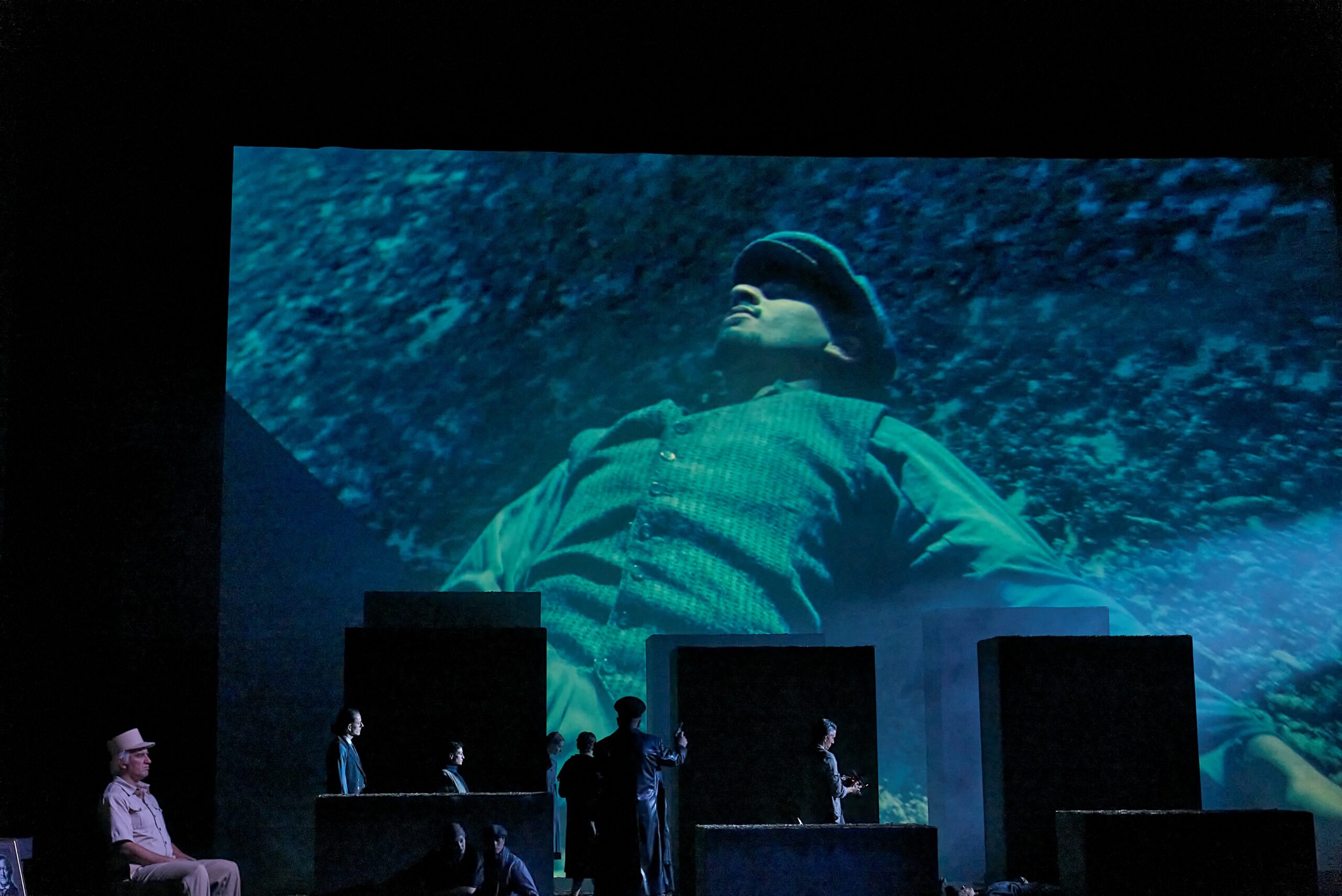
The transition to the scene featuring the steersman’s song (“Mit Gewitter und Sturm”) is just as skilfully executed. Anton Lukas, a long-standing collaborator of Milo Rau, has designed a stage set for this production that is both effective and evocative. Thus, the extended Deutsche Oper chorus, dressed in sand-coloured combat fatigues and with handkerchiefs pinned over their noses, first uncovers the bodies – a scene evoking the Allied troops’ entry into the extermination camps – before transforming into Israelis for the Dutchman’s monologue and the “bargain” scene. The screen is ever-present: during ‘Die Frist ist um’, we watch ripples on the Tel Aviv seafront at night, whilst the music evokes a violent storm. Then, we see a motorway in Israel; the sign reads “Tel Aviv”. The camera then guides us into a house where we find an elderly gentleman: “Chaim Shilo, aged 102, a survivor of the attack on 7 October”, the text informs us.
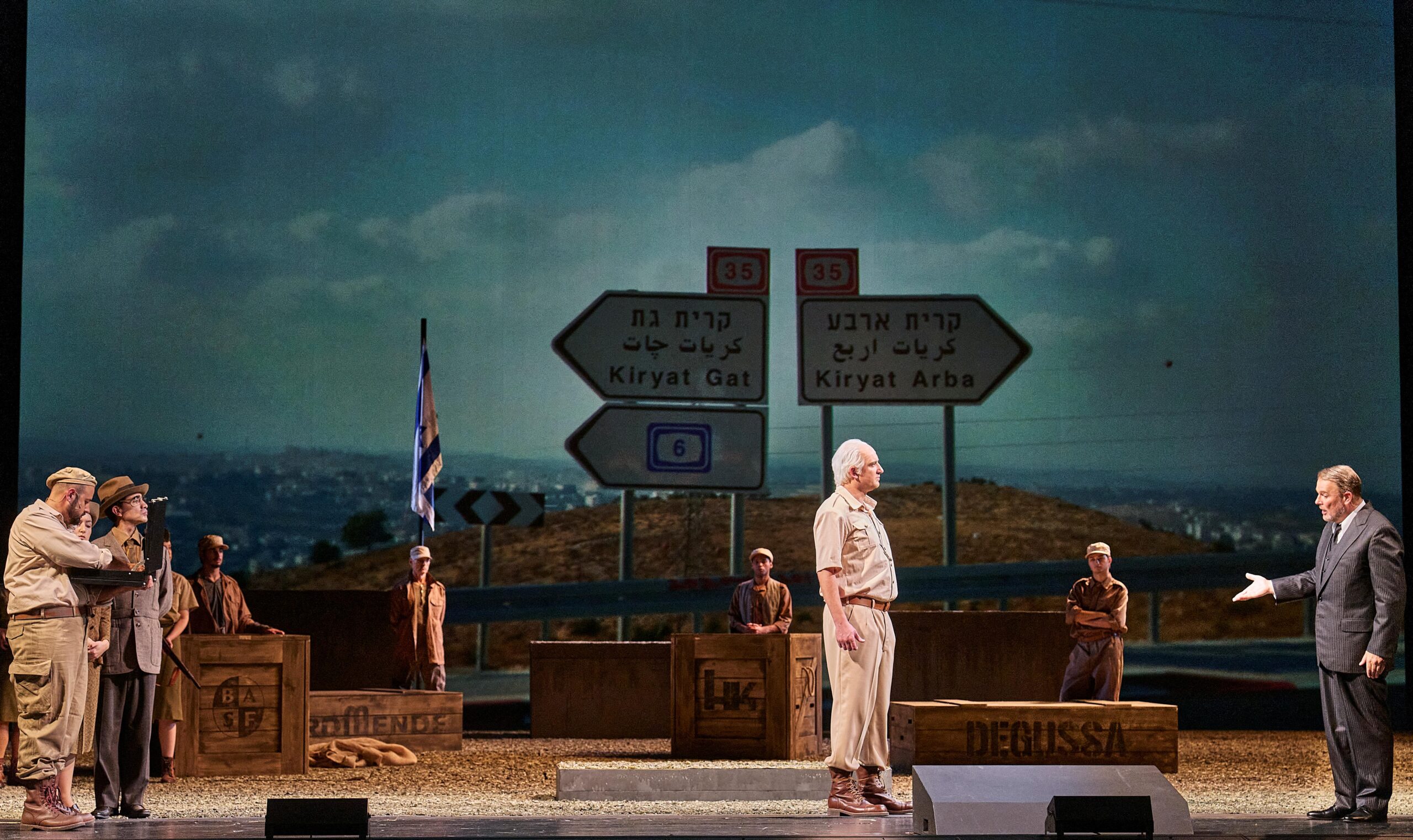
Meanwhile, the “bargain” scene is being set up. The projected text informs us that ‘Israel has sought to establish diplomatic relations with every country except Germany’ and, on stage, a small group – looking more like a Lufthansa crew in Hugo Boss uniforms than an Israeli delegation from the 1950s – are negotiating. Israel’s founding fathers, represented by Daland (Tareq Nazmi), will eventually seal the deal and accept the German money. But not just any money. The crates stamped ‘BASF’ and ‘Degussa’ represent the treasure the Dutchman will offer Daland in exchange for his daughter. IG Farben (of which BASF was a part) and Degussa held 85 per cent of the shares in Dagesch, the holder of the patent for Zyklon B, the hydrogen cyanide used in the gas chambers. An iconic symbol of German industrial power in the 1950s – the three-pointed Mercedes-Benz logo springs to mind – was undoubtedly not morbid enough to allow Rau to suggest a moral compromise on the part of Israel that was sufficiently staggering to satisfy the needs of his narrative.
On screen, the Wagnerian road movie through Israel continues. We see signs for Kiryat Arba in the West Bank and follow Sarah von Schwarz and Schlomi Wagner from one Wagnerian event to the next. At the same time, the surtitles projected onto the screen provide historical explanations. For example: ‘The State of Israel was established in 1948. After independence, 700,000 Palestinians were expelled. This is the Nakba.” Does Milo Rau genuinely believe that his audience knows enough about the history of the Israeli-Palestinian conflict to fill in the gaps? Or is he deliberately taking misleading shortcuts? In this instance, he fails to mention that in the wake of its declaration of independence on 14 May 1948, Israel was attacked by a coalition of five Arab countries, triggering the First Arab–Israeli War, which lasted until early 1949 and in which 20,000 Holocaust survivors fought.
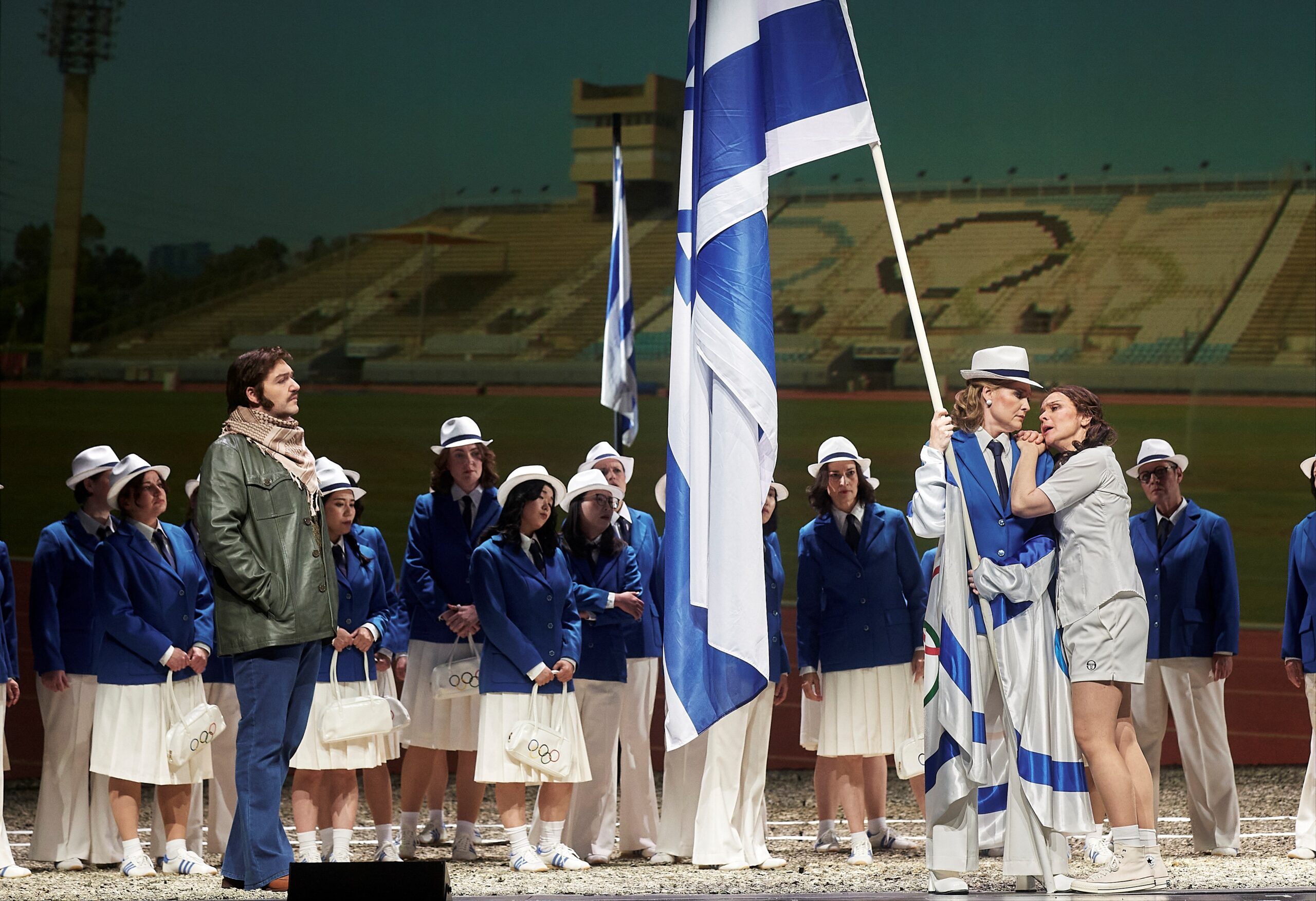
Act II opens with the 1972 Olympic Games, the first to be held in Germany since 1936. The chorus on stage wears blue-and-white suits inspired by the Israeli flag and sings ‘Summ und brumm, du gutes Rädchen’, brandishing placards ‘Peace’ and ‘Friendship’. In the foreground, Mary (Kai Rüütel-Pajula) waves a giant Israeli flag. Senta (Ausrine Stundyte), wearing shorts and a white shirt, a blue tie and pigtails – representing a somewhat infantilised young state of Israel – makes her entrance. On the screen, we see Gad Tsabari recounting his escape under a hail of bullets fired by terrorists, whilst, on stage, a man in a white T-shirt and shorts tries in vain to attract the attention of the people in suits and ties.
Erik (Attilio Glaser), sporting a keffiyeh, wanders amongst this huge Israeli delegation, and the text on screen explains: “Whilst Israel was occupying Gaza and the West Bank following the Six-Day War, the Israeli delegation travelled to Munich.” Five years separate these two events, but for the Swiss artist, this is no doubt “a mere detail of history”. Gaza and the West Bank, controlled by Egypt and Jordan respectively, were occupied by Israel between 7 and 10 June 1967, whilst the Munich Olympic Games took place in September 1972. The text reads: “The release of political prisoners was demanded in exchange for the athletes. Israel refused everything.”
“Senta’s Aria” is the piece around which Wagner built the rest of his opera. Though sublime in its beauty, the aria is formidably difficult to sing, given the vast range between the full, rich low notes and the brilliant, piercing high notes. Despite the fundamental importance of this aria in The Flying Dutchman, Milo Rau saw fit to project onto the screen above the stage the Israeli soprano Tamara Nashri, who was singing the same piece, but out of sync, at Jerusalem Central Station. A juxtaposition that was as distracting as it was pointless. Ausrine Stundyte sang “Senta’s Ballad” with great expressiveness, alternating between stark contrasts of agitated and lyrical passages, displaying beautiful vocal flexibility and admirable stage presence, despite her ridiculous costume. Her projection was remarkable and carried effortlessly over the orchestra, which was well balanced under the baton of her compatriot, the Lithuanian conductor Giedrė Šlekytė. Despite the distracting staging, which made it hard to listen, we still appreciated her clear, precise conducting and her attentiveness to the singers on stage.
Whilst Mary and the chorus sing “Ach! Wo weilt sie”, hooded and armed figures seize the Israeli athletes, one after the other, in a wonderfully choreographed scene. Erik sings “Bleib Senta”, and the couple become embroiled in recriminations and accusations. In a spirit of defiance, Senta clutches Wagner’s portrait even tighter to her chest, even kneels before him. Next comes Erik’s sublime aria “Auf hohem Felsen lag ich träumend”, remarkably performed by the tenor Attilio Glaser.
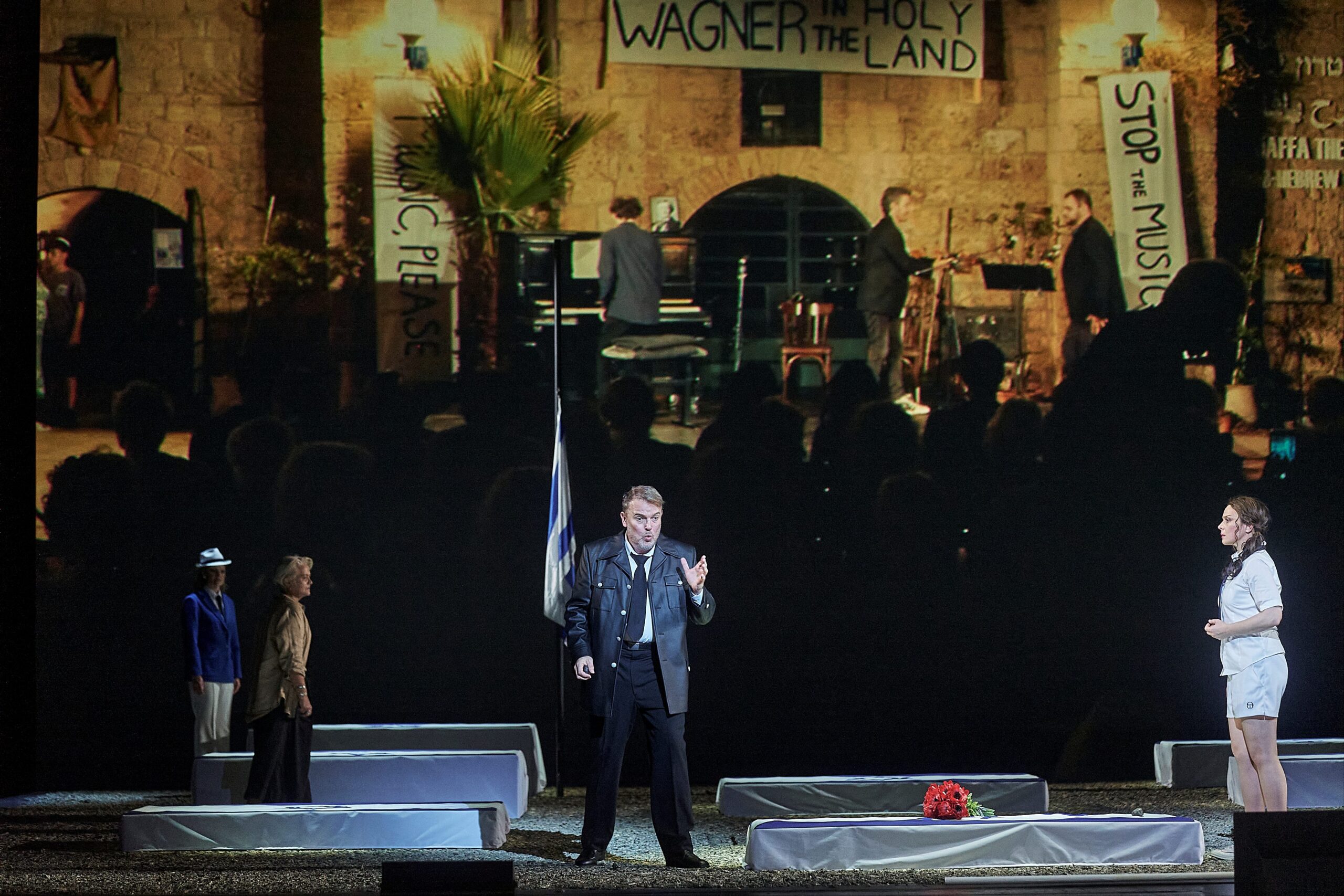
The re-enactment of the night-time scene at Fürstenfeldbruck Air Base is excellent, provided that the audience has sufficient historical knowledge to understand that this was a massacre, as the subtitle is succinct: ‘None of the eleven hostages survived. They died during the rescue operation’. This wording obscures the fact that the Israeli athletes were executed by Palestinian terrorists and leaves open the possibility that they died accidentally in crossfire. By contrast, it is clearly stated that ‘Israel killed all those responsible for the attack’. The concrete blocks of the Berlin Memorial slowly come into view, and Mary covers, one by one, the graves of the massacred Israeli athletes with an Israeli flag. On screen, we see the “Wagner in the Holy Land” event taking place in the presence of the president of the Israeli Wagnerian Association, Yonatan Livni, whilst the text informs us that in Jaffa, “200 people attended the concert”.
Many audience members were too busy following the flurry of activity on the screens to notice the man in black, who had discreetly taken his place behind a music stand at the edge of the stage and begun to sing “Wie aus der Ferne”. Tomasz Konieczny lost his voice and had to be dubbed for the grand duet between Senta and the Dutchman. This duality of “Germany” – one gesticulating, the other audible – could have almost distracted us from its coitus with “Israel” on one of the athletes’ graves, to which the disembodied voice coming from the wings lent a macabre touch that even Rau could not have invented. It shows that reality sometimes surpasses fiction. To exploit the grim potential of his narrative to the full, Rau makes the duet between Senta and the Dutchman—the emotional and psychological heart of The Flying Dutchman and its cathartic musical climax—coincide with Yitzhak Rabin’s 1975 visit to Bergen-Belsen.
After the interval, the artistic director of the Deutsche Oper, Aviel Cahn, explained that Tomasz Konieczny was unwell and would be replaced vocally – but not on stage – by Derek Welton. Sympathetic applause for Konieczny welcomed the news. Schlomi Wagner and Sarah von Schwarze, seated on either side of the stage, continue their account of their journey to Israel, reminisce about their encounters and share their reflections.
“There are a thousand reasons to leave and a thousand reasons to stay,” says Sarah von Schwarze, her voice trembling imperceptibly, “But what sort of place are we going to create?” or “What am I doing here? I am neither truly Jewish nor truly German. My parents went to Israel to atone for their country’s guilt. Where should I go?” For his part, Schlomi Wagner explains that, in the occupied territories, “the Palestinians have no rights” and that “these are the consequences of the Holocaust and anti-Semitism.” To emphasise the link between the Holocaust and the war in Gaza, the subtitles explain: ‘Yad Vashem teaches us that we can never be weak again. Young soldiers are taken there before they are sent to the front in Gaza.” Standing before the screen showing the white memorial stones, Von Schwarze, her voice breaking, explains: “Deep in the forest at Yad Vashem lies the memorial to the murdered children.”
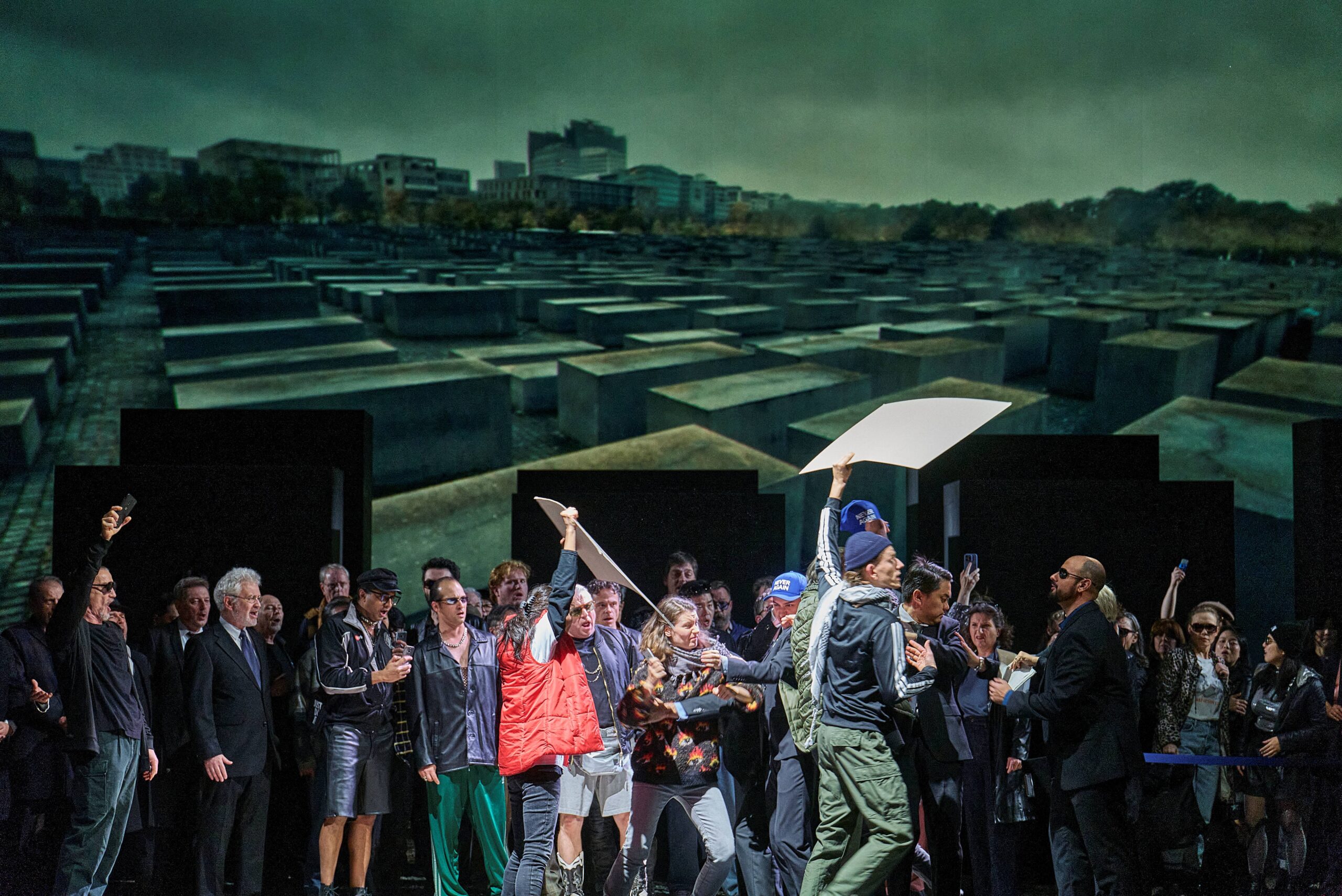
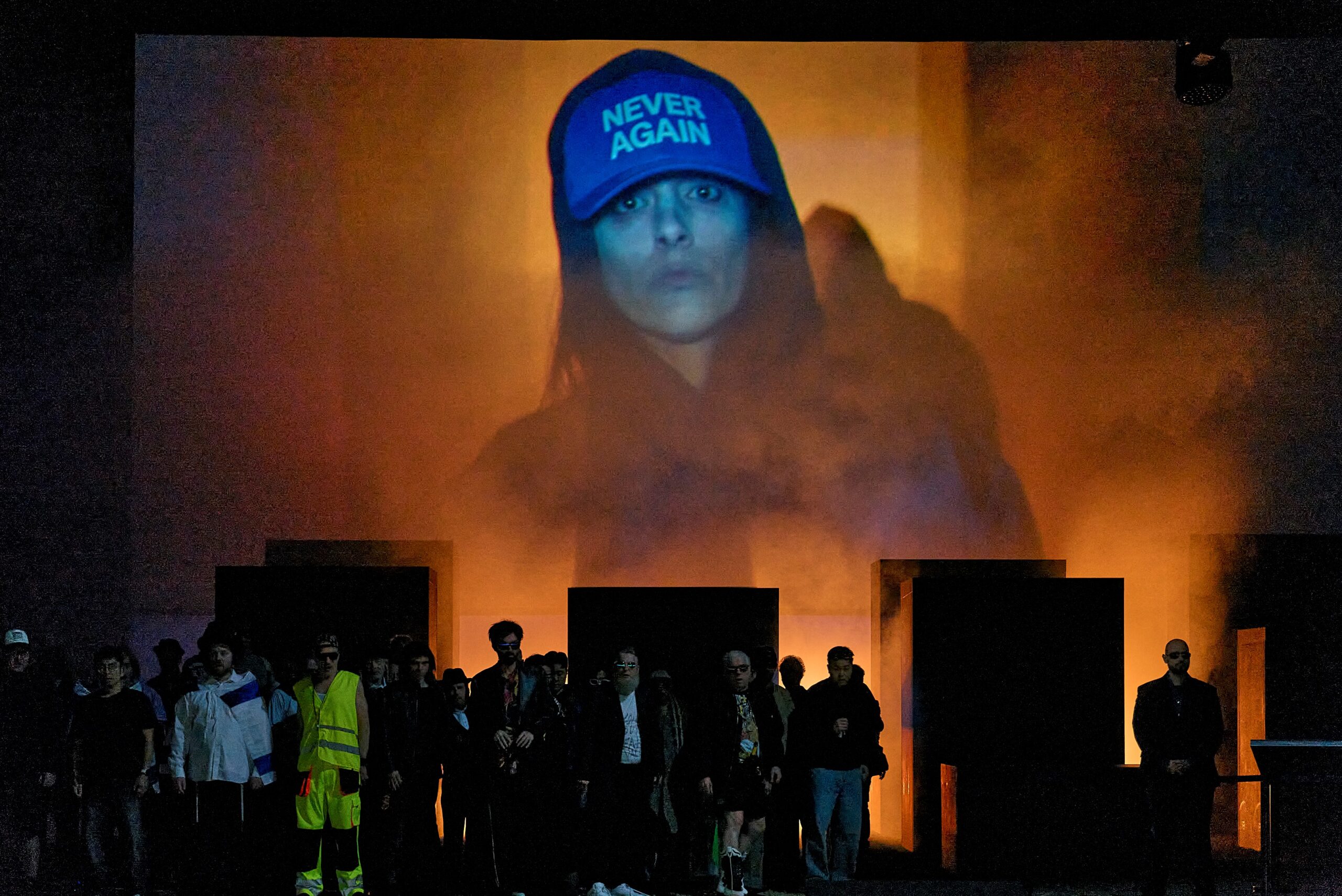
Meanwhile, the stage fills with people, officials, an Israeli delegation, and bodyguards surrounding the German president, all wearing “Never Again” caps: we are witnessing the inauguration of the Memorial to the Murdered Jews of Europe in Berlin in 2005. Erik disrupts the festivities, flanked by a few activists brandishing placards reading “Free Palestine from German guilt” and “Never again is for everyone”. What follows is a beautifully shot, elegantly choreographed scene of confrontation between the police and the demonstrators. “Then something happened that no one thought possible,” the on-screen text reads: “The rise of the far right in Germany. Germany’s ancestral crimes should be replaced by pride. Guilt has become a weapon.”
A third scene, filmed live and set in darkness, is as skilfully constructed and powerful as the first two. To the sound of “Wahrhaftig, ja! Sie scheinen tot!”, Lukas conjures from the darkness—like zombies from a past that refuses to pass—pale figures, bathed in cold, brutal light, wearing “Never again” caps. They gather at the front of the stage, in combat fatigues and “Never again” caps, chanting “Johohoe! Johohoe!”. Ausrine Stundyte returns to the stage, without her wig and wearing a black trouser suit and a small mauve necklace — a particularly uninspired outfit — for the dénouement devised by Milo Rau, which will see Senta and Erik, “Israel” and “Palestine”, die in order to save the Dutchman, “Germany”. Shot at point-blank range by Mary, the character representing none other than an “elite soldier” of the IDF, Erik nevertheless continues to sing ‘Cavatine’ for several minutes – an aria of passionate, almost heroic intensity – with a vigour that reveals the full extent of the narrative absurdity of this graft. Meanwhile, Israeli landscapes flash across the screen until Erik finally dies.
Freed from her shorts and pigtails, Ausrine Stundyte seems to regain a far more assertive stage presence. Her frustration and anger are no longer the whims of a little girl infatuated with a phantom, but the self-destructive exasperation of a Katerina Ismailova. Her high notes convey this with the emotion of her character in this production. For Rau’s Senta is not Wagner’s Norwegian maiden who throws herself off a cliff for the love of a mysterious stranger. She embodies “Israel”, which must perish in order to absolve “Germany” of its historical guilt towards it. Ausrine Stundyte understood the significance of this death and – the incomparable performer that she is – sang it with chilling emotional fidelity. She does not blow her brains out in the spirit of self-sacrificing devotion of a Saint Agnes, but in the cold rage, full of pride and courage, of a yakuza who commits hara-kiri, after removing his $250,000 watch so as not to soil it.
After this minimalist bloodbath – apart from the two revolvers and Stundyte’s perfect fall – nothing hints at the scale of the disaster – the Israeli road movie draws to a close as well. We see, for the last time, Sarah von Schwartze and Shlomi Wagner, side by side, on the “reporters’ hill” in Sderot, less than a kilometre from the border with Gaza, and which has become the gathering point for the international press, barred by Israel from entering Gaza. At one point in the road movie, speaking via FaceTime, a Palestinian artist says: “Guilt is narcissistic. It centres on you. You must transform it into responsibility, otherwise it will never go away.”
Instead of tackling the subject of the relationship between Germany and the Jews, and subsequently with Israel, with a sense of artistic responsibility commensurate with the stakes, Milo Rau has provided a perfect – albeit perhaps unintentional – illustration of that narcissistic guilt which inexorably creates its own victims. Tonight, the list is a long one: Wagner’s music; the history of relations between the Jews, and later Israel, and Germany; the history of the Israeli-Palestinian conflict; the musicians on stage and in the orchestra pit, all excellent, though relegated to playing the live soundtrack to Milo Rau’s cinematic spectacle; and the audience too: those who came for the music and those who came to be surprised, inspired or shocked. Even the police outside the Deutsche Oper, on standby in case of riots, looked disappointed.
Visuels : © Matthias Horn

