


The Choreographic Convention, Moving in November Style: Together Is Everything
par Amélie Blaustein14.11.2026

We start together, we finish together. In between, 22 groups—yes, 22 groups—following a shared session from 12:00 PM to 1:30 PM, took part from 2:00 PM to 8:30 PM in one of the many choreographic itineraries that, throughout the day, proved once again that the freest, most inventive, and most deconstructed scene is on this side of Europe.
On paper, the whole affair sounds very academic. This convention is the 4th of its kind. A bit like Eurovision, the designated—rather than winning—country has to host it. ChoreoCon #4, as it is affectionately known, is also the final edition of this annual symposium organized by the European network Life Long Burning. In the vision of Kerstin Schroth—which, as a reminder, always centers on the audience’s gaze both in and on the works—movement had to be an integral part of this big day. So, the meeting point was set for noon sharp at the beating heart of the festival, Caisa. We were assigned number 6; for this group, the schedule was as follows:
-
12:00–13:30 | Soup Talk Panel – Michael Turinsky, Noora Karjalainen, Riina Hannuksela | Caisa, Kaikukatu 4
-
14:00–15:00 | Myco-choreography Salon – Maija Hirvanen | Light House, Academy of Fine Arts, Sörnäisten rantatie 19
-
16:00–16:30 | Sketched Story in Single Images – Jana Unmüßig | Caisa, Kaikukatu 4
-
16:45–17:30 | An étude on choreographic practice – Suvi Kemppainen | Caisa, Kaikukatu 4
-
17:45–18:15 | Panbox_0001 – Lydia Touliatou | Caisa, Kaikukatu 4
-
20:00–20:30 | Last Hurrah – Sara Grotenfelt | Caisa, Kaikukatu 4
Bread, Soup, and Shared Crip
And yes, this convention day kicked off with Moving in November’s signature morning ritual: the Soup Talk. The concept is simple: bread, spreadable cheese, and the soup of the day are laid out. You walk into the lecture hall, help yourself, and eat. Once everyone is settled in, the discussion begins with choreographer Michael Turinsky and artist-researcher Noora Karjalainen, moderated by researcher Riina Hannuksela. The conversation revolves around the notion of Crip—the political, theoretical, and artistic movement that subverts ableist norms by reclaiming disabled and neurodivergent bodies as equal to all others. Both Michael and Noora emphasize the infantilization they face and the thousand obstacles that still stand in the way of true inclusion. Afterward, the audience is split up and remains so until the convention’s “conclusion.” One of the core pillars of this convention, then, is being together—truly together, as equals, without silencing our differences. The time spent in groups allows for exchanges before, during, and after the performances.
Maija Hirvanen’s Choreographic Mycelium
For our first stop, we head toward the ultra-modern art school, all glass and concrete. And at the very, very top of the building, Maija Hirvanen awaits us, wearing a white cap dotted with large white mounds on her head and a smile on her face. Myco-choreography Salon is an entirely participatory work of the most original kind. It begins around a table. On this table sit mushrooms looking like old stones. Then Maija talks about mycelia that live in defiance of any center, teaching us that these fungi hide a thousand wonders. She serves us something resembling tea—a mushroom infusion with a light, woody taste and immediately soothing properties. Then, after smelling and listening, we look through a magnifying glass at these famous invisible roots. The first choreographic gesture, therefore, is to press a magnifying glass to one eye, squeeze the other shut, and bow our heads over this little white brick that reveals a billion branches. In a gentle progression, the dance truly arrives: first in pairs, then the whole group together, we watch our hands and our partner’s hands move slightly, letting the energies vibrating in our palms circulate; then our gaze lifts, along with our bodies, and almost as if by magic, our hands—and soon our entire arms—coordinate as if they were listening to one another.
Jana Unmüßig and the Poetry of the Infra-Ordinary
After a break, we return to Caisa for the afternoon’s second offering: Sketched Story in Single Images by Jana Unmüßig. For this short 30-minute piece, the Helsinki-based German choreographer asked Myrsky Ylänen to “dance” an unpublished text due out this winter from Errant Bodies Press. His solo is built on micro-movement. We find him between two soft lights in a Japanese seiza posture, then in child’s pose; while reciting Sanni’s disjointed and equally monotonous daily life in an excessively flat tone, he shifts ever so slightly, eventually lying down, rolling over, and sitting almost in a twist. The story suspends us between boredom, to-do lists, watching hares or the rain, and the simple, witnessing awareness of one’s own body. In doing so, this excerpt brushes against the poetic density of the infra-ordinary.
Suvi Kemppainen: A Sour Candy Between Britney and Eiffel 65
Fifteen minutes later, we change spaces and styles for one of the massive highlights of this packed day. Finnish choreographer and dancer Suvi Kemppainen delivers a forty-minute short form featuring excerpts from her works. An étude on choreographic practice is a lesson in letting go that hits the mark. Suvi introduces fresh gestures—such as crossing her arms while her hands tap her forearms, or an entire routine pushed to its absolute limit exploring the sound made by the arches of the feet. The choreographer performs as a duo, and neither of them is afraid of looking ridiculous, much less of proximity to the small audience; there are about ten of us watching Suvi’s eyes go wide as she types on an invisible keyboard, her body posed like a sphinx (Editor’s note: any resemblance between this posture and ours, right now at 11:12 PM, is purely coincidental), leaving us in stitches. Later, she embraces her status as an absolute Britney fan by performing, while seated, the key choreography of I’m a Slave 4 U, set to Eiffel 65’s Blue (Da Ba Dee). We laugh our heads off, yes—but that’s not all! There is a delightfully sharp reflection on “doing things right” and on the urge to get on stage to show oneself off over and over again. Pure sour candy that hit the spot during this marathon day.
Lydia Touliatou’s Hiccuping Archives
With no transition, we meet Lydia Touliatou for a very promising early work-in-progress on personal archives. Panbox_0001 plays with vintage tropes, featuring an old TV tuned to static. From her jeans with a thousand pockets, the dancer pulls out game controllers; her body hiccups like Dana Michel’s—perhaps a sign of the times—where freeze-frames tremble slightly. We see her as a very young child next to her father. Ghosts scream around her when she closes her eyes, wondering perhaps who that little girl in the pretty little dress is; what to do with memories—those that remain and those forgotten out of necessity, which photographs cannot reactivate? Play with them, evidently. One to watch.
A Finale Shaped Like an Awkward, Fragile Party
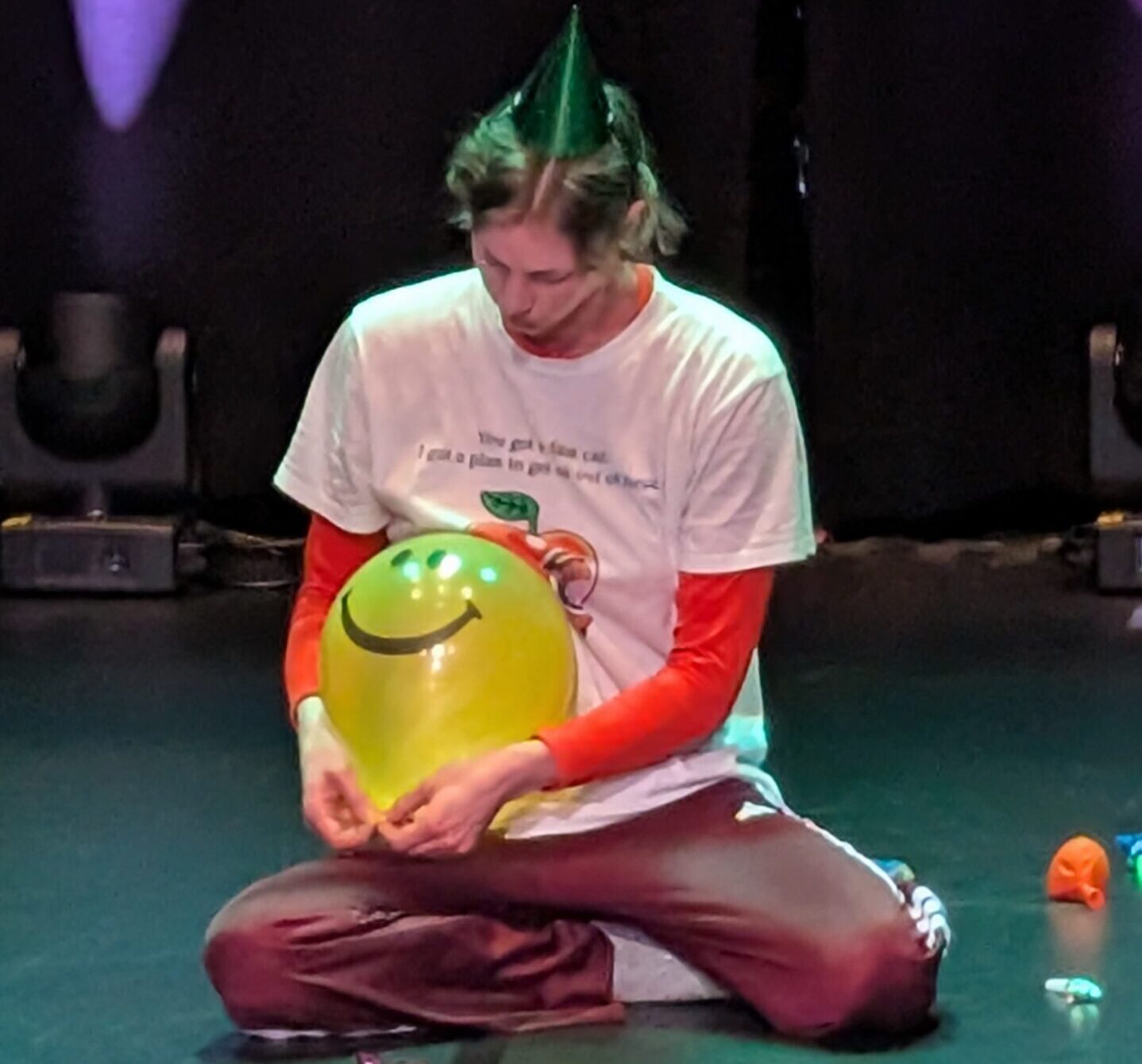
At the beginning of this overly long article, we told you that the idea of this convention was to be together from start to finish. Well, by way of conclusion, there were no speeches, but rather a strange party with a heavily ’90s soundtrack. This solo, Last Hurrah, was created in 2022 by Sara Grotenfelt—post-Covid, in other words. Here we are, armed with little party hats and party blowers, wickedly called “mother-in-law tongues” in French. The social pressure to party and have fun hangs heavy in the air. At first, it’s playful. Balloons emerge from behind the curtain, and we are supposed to blow our whistles if we’re having fun. Then she arrives, and the awkwardness is immediate. To Robert Miles’s Children (perhaps the anthem of 1995), she enters and gallops in place on one leg, then pulls off her sweatpants and continues in slightly loose gray underwear. Face tense, she gives it her all, stuffing party blowers almost everywhere and blowing with her entire face. The party is in full swing, Avicii is on the decks, it’s soon time for a slow dance to Billie Eilish, and right then, Sara Grotenfelt floors us with the image that sums up the entire convention: joy is as rare as it is fragile, and we must take care of it—just like her, cradling a balloon printed with a smiling yellow emoji; she squeezes it tight, it deflates, yet it holds on, just as we did for 8.5 hours, going from room to room to discover the entire choreographic scene of the region alongside professionals from all over Eastern Europe.
Moving in November, through November 15 in HelsinkiInformation and bookingsPhoto © Amélie Blaustein
